
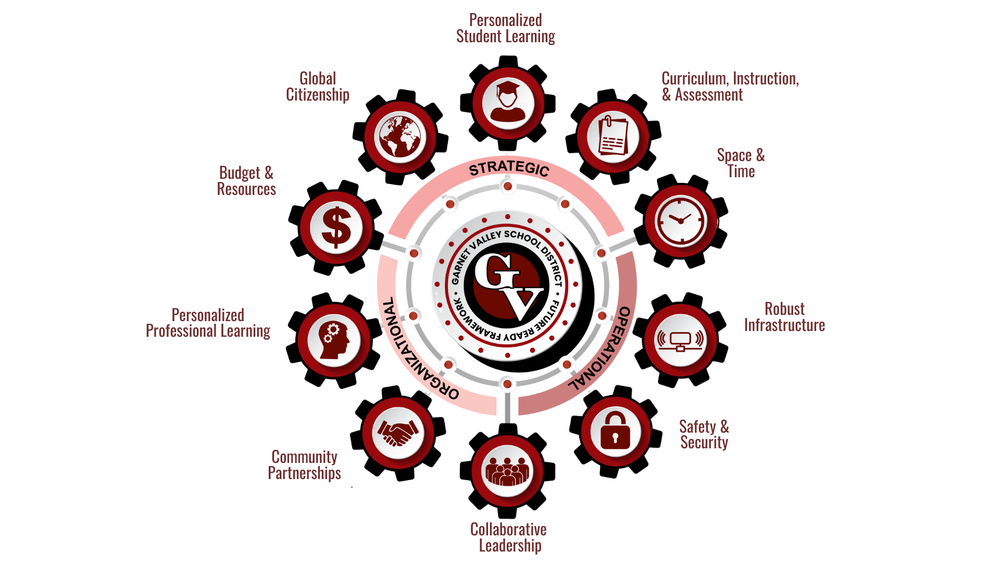
At Garnet Valley we set clear priorities that guide everyday work in classrooms, buildings, and district offices. Our strategic plan names those priorities and sets timelines. The Future Ready framework gives us a practical structure to turn those priorities into actions families will see and feel. The result is steady focus on learning, equity, staff support, and long-term stewardship.
Our strategic priorities
Promote student growth and equitable outcomes.
Build teacher capacity with job-embedded professional learning.
Use technology with clear instructional purpose and protect student data.
Support well-being, safety, and stronger family and community partnerships.
These priorities are organized into near-term and multi-year timelines so families and staff can see what happens now and what we plan next.
What the Future Ready framework means for Garnet Valley
Future Ready breaks district work into practical areas we call gears. It helps us make sure plans are connected, not scattered. The gears we use are:
Curriculum, instruction, and assessment.
Use of data to inform teaching and operations.
Professional learning and leadership.
Technology and infrastructure that supports learning.
Family and community partnerships.
Our Future Ready framework maps each gear to district actions, building practices, and classroom examples so families can see how strategy becomes daily practice.
How priorities and the framework show up where it matters
For students: we use frequent, brief checks of learning to identify who needs extra help and who is ready to move ahead. Teachers use that information to plan small-group instruction. This comes directly from our curriculum and data work.
For teachers: professional learning focuses on classroom practice. That includes coaching cycles, PLCs, and badges to track progress. Teachers get feedback that is tied to student results.
For families: we expand two-way communication and offer practical tips families can use at home to reinforce classroom goals. The goal is useful, timely updates—not more email.
For operations: facility investments and systems changes are phased so spaces and staffing match instructional priorities over time. The 10-year facilities plan guides those investments.
Recent, concrete steps the district has taken
We established a phased AI and learning roadmap to improve instruction and support staff over the next few years. That work includes pilot partnerships and credits for teacher learning.
We completed decisions around instructional devices and infrastructure to align with learning goals and long-term stewardship. These decisions help standardize classroom tools and support consistency.
We are rolling out micro-credentialing and practical, gamified professional learning that ties to classroom practice and can be tracked over time.
What families should notice this year
Clearer updates about what students are learning and why that learning matters.
Short assessments used to guide instruction, not to label students.
More teacher coaching and consistent school-to-school practices so teaching improves faster.
Practical family events and communication that show how to support learning at home.
How we measure progress
Student growth, disaggregated by subgroup, to check equity.
Implementation indicators for PLCs and coaching cycles.
Usage and impact measures for instructional tools and new programs.
Family engagement and feedback metrics tied to events and communications.